
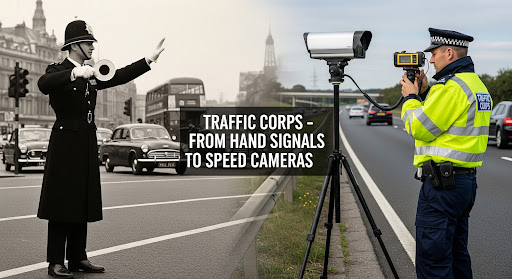
Few areas demonstrate the Garda’s adaptability quite like traffic policing. From the earliest days of motorised transport to today’s high-tech enforcement systems, the journey of the Garda Traffic Corps tells a compelling story of innovation, challenge, and public safety.
The Early Days: 1920s-1940s
When An Garda Síochána was established in 1922, Ireland’s roads were vastly different from today. Motor vehicles were a relative novelty, sharing unpaved roads with horse-drawn carts, bicycles, and livestock. The first traffic regulations were rudimentary, and enforcement relied heavily on the presence and authority of uniformed Gardaí stationed at key junctions.
In those early decades, Gardaí directed traffic using hand signals and whistles—a skill that required training and composure. The iconic image of a Garda standing in the centre of a busy Dublin intersection, white gloves raised, became synonymous with order and authority. These officers were not merely directing vehicles; they were managing a cultural shift as Ireland transitioned into the motor age.
Post-War Expansion: 1950s-1960s
The post-war period brought increased vehicle ownership and, consequently, greater challenges for road safety. The 1950s saw the introduction of more sophisticated traffic management techniques. Gardaí began using motorcycles for patrol duties, allowing for greater mobility and faster response times to incidents.
The Road Traffic Act 1961 was a watershed moment, providing comprehensive legislation covering vehicle standards, driver licensing, and traffic offences. This act empowered Gardaí with enhanced authority to enforce road safety and marked the beginning of more systematic traffic policing in Ireland.
The Birth of the Traffic Corps: 1960s-1970s
Recognising the need for specialised traffic enforcement, the Garda Traffic Corps was formally established in the late 1960s. These specially trained officers were equipped with high-powered vehicles and tasked with patrolling national routes and motorways.
The 1970s brought new challenges as vehicle numbers soared and road fatalities reached alarming levels. The Traffic Corps responded with increased visibility and enforcement. Speed detection equipment began to appear, though in its infancy, it was far from the sophisticated technology we see today. Early radar guns were bulky and required careful calibration, but they represented a significant step forward in objective speed enforcement.
Modernisation: 1980s-1990s
The 1980s and 1990s saw dramatic improvements in both vehicle technology and enforcement capabilities. The introduction of the penalty points system in 2002 (though debated throughout the previous decade) would eventually revolutionise how traffic offences were managed, creating a cumulative consequence for persistent offenders.
During this period, the Traffic Corps expanded its remit to include collision investigation, working closely with forensic experts to determine causes and prevent future incidents. Breath testing for alcohol became routine, and the Christmas drink-driving campaigns became an annual fixture, supported by high-profile media campaigns.
The Digital Age: 2000s-Present
The 21st century has transformed traffic policing beyond recognition. Today’s Traffic Corps officers have access to technology that their predecessors could scarcely have imagined:
- Speed cameras: Fixed and mobile speed detection systems now monitor roads 24/7, with automated systems issuing notices to offenders.
- ANPR technology: Automatic Number Plate Recognition systems can instantly check if vehicles are taxed, insured, and registered, flagging potential offences in real-time.
- Collision reconstruction software: Advanced computer modelling helps investigators understand exactly what happened in serious collisions.
- Drug testing: Roadside drug testing equipment, introduced in 2017, allows Gardaí to detect drug-impaired driving alongside traditional alcohol testing.
- Data analytics: Sophisticated analysis of collision data helps identify high-risk locations and times, allowing for targeted enforcement.
Contemporary Challenges
Despite technological advances, the Traffic Corps faces ongoing challenges. Distracted driving—particularly mobile phone use—has emerged as a major concern. The increase in electric and hybrid vehicles presents new considerations for road safety and enforcement. And while overall road deaths have decreased significantly since peak levels in the 1970s, every fatality remains one too many.
The GoSafe speed camera network, operated by Gardaí in partnership with private contractors since 2010, has proven controversial but effective. Studies consistently show reduced speeds and fewer collisions at monitored locations, though debates about their purpose—revenue generation versus safety—continue in public discourse.
Looking Forward
As we approach the centenary of An Garda Síochána in 2022 and beyond, the Traffic Corps continues to evolve. Autonomous vehicles, connected car technology, and artificial intelligence present both opportunities and challenges for future road policing.
What remains constant, however, is the fundamental mission: keeping Ireland’s road users safe. From the Garda with white gloves directing traffic in 1920s Dublin to today’s officer monitoring multiple screens of data in a patrol car, that core purpose endures.
The journey from hand signals to speed cameras represents more than technological progress—it reflects Ireland’s transformation into a modern, mobile society. The Garda Traffic Corps has been there every step of the way, adapting, innovating, and serving.
Written by Sean Daly Garda