
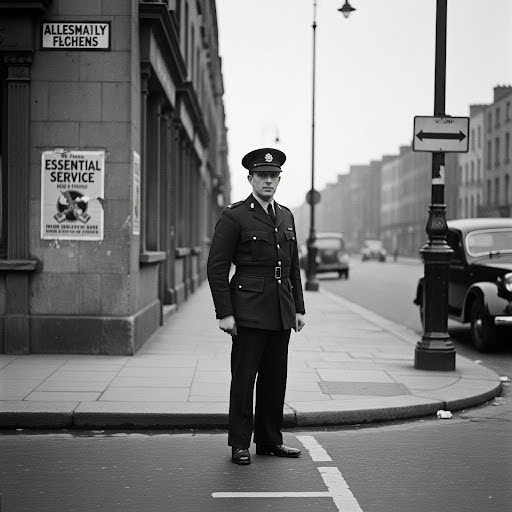
When we imagine the Irish Garda (as the force was often called in everyday speech in the interwar years), it is easy to picture a uniformed figure on a bicycle, a steady presence at a crossroads, or a calm voice at the counter of the local barracks. The truth, as always, was messier. A 1930s Guard was expected to be at once a peacekeeper, clerk, messenger, welfare contact, and moral representative of the State.
This post is a look at what an ordinary day could feel like for an ordinary Guard in the 1930s: the pay packet, the relentless paperwork, and the public expectations that followed the uniform everywhere.
1. The Day Begins: Parade, Discipline, And The Station Diary
A Guard’s day was anchored by routine.
Parade and instructions set the tone, with an orderly check of turnout and a run-through of duties for the day. The station diary and any outstanding reports shaped priorities, and even a minor incident from the night before could generate a surprising amount of writing. And before any patrol, the uniform itself was part of the job: boots polished, belt squared, cap set right – not vanity, but a statement that the young State could keep order.
For Guards posted in smaller rural stations, the same building might be office, reception, and living quarters. The boundary between “on duty” and “off duty” could be thin.
2. Pay: Steady Work, But Rarely Easy Money
A Garda job was sought after because it was steady, but that did not mean it was generous.
Regular pay offered security that many other lines of work did not, but costs followed the uniform: maintaining appearance, travel, and the everyday expense of being presentable added up quickly. Family pressure was real too; for a Guard supporting a household, the wage had to stretch.
Pay also carried an invisible price: the expectation of propriety. A Guard was watched for signs of debt, drink, gambling, or company that might damage the force’s reputation.
3. Paperwork: The Quiet Engine Of Policing
The romantic image of patrol work fades quickly when you meet the forms.
A 1930s Guard might spend hours on:
Statements and witness accounts, summonses and court files, property registers and evidence notes, as well as routine licensing and permits. Add to that the steady correspondence with headquarters and local officials, and the hours could disappear at the desk.
Even in minor matters, the paper trail mattered. The Garda was building credibility in a society that had recently lived through revolutionary upheaval. Records were part of proving fairness, consistency, and authority.
4. Patrol Work: Visibility, Local Knowledge, And Small Disputes
Many duties were about presence rather than dramatic intervention.
Foot patrols and bicycle patrols kept a Guard visible and accessible, while local knowledge did much of the real work: knowing who was feuding, who was out of work, and whose grievance might turn into a fight. The disputes themselves were often small and familiar – cattle trespass, boundary arguments, or a public house row at closing time – but they still demanded judgement.
A key skill was reading the room. Knowing when to warn, when to mediate, and when to bring the weight of the law was the difference between peace and escalation.
5. The Public Counter: Service, Suspicion, And The State’s Face
In many communities, the station was the local point of contact with the State.
People came in to:
Report thefts, missing property, or assaults; seek help with letters, forms, and official processes; ask about local regulations and requirements; and, often, simply look for reassurance in anxious times.
But the counter could also be a place of tension. The 1930s were not distant from civil conflict in memory. Trust had to be earned, and it could be fragile.
6. Court Expectations: The Guard As Witness And Professional
A Guard’s job did not end with an arrest or a report. Court was a world of its own.
Accuracy mattered, because sloppy notes could unravel a case. Composure mattered too, as a Guard’s behaviour shaped how the force was perceived. And preparation mattered, because files had to be right and the story had to be consistent.
For many Guards, court days were among the most stressful. The uniform did not guarantee respect inside a courtroom. Credibility had to be demonstrated.
Closing Thoughts: A Working Life Built On Trust And Routine
A day in the life of a 1930s Guard was rarely like the dramatic cases that survive in newspaper headlines. It was built on routine, records, and relationship management. The pay was steady, the paperwork endless, and the public expectations unrelenting.
Yet it is in that ordinary rhythm – the patrol, the counter conversation, the careful notes before court – that we can see how the Garda became embedded in everyday Irish life.
If you would like, I can follow this with a second post on how Guards policed festivals, fairs, and pattern days in the early twentieth century, and what changed by the mid-century.
Written by Sean Daly Garda