
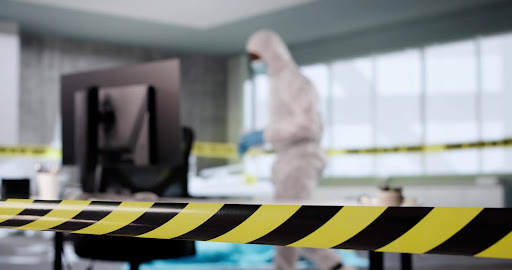
For most people, “forensics” in policing arrives already fully formed: a swab, a lab, a match, a courtroom moment. In Irish policing, as in policing everywhere, it has been a slower story. It is a story of ink-stained fingers and patient record-keeping, of microscopes and careful measurement, of the human need to make sense of traces left behind. And, in recent decades, it has become a story of DNA.
As a Garda historian, I am often asked when “modern” forensic science truly began in Ireland. The honest answer is that there was no single starting gun. There were, instead, a series of quiet revolutions. Some were technological. Some were organisational. Some were cultural: the gradual acceptance that good policing is as much about documentation, preservation, and procedure as it is about instinct.
The Early Promise Of Fingerprints
Long before DNA entered public vocabulary, fingerprints offered something police forces had long craved: a means of identification that did not depend on names, memory, or witnesses. The idea that a person’s unique ridge patterns could tie them to an object, a place, or an event was both elegant and powerful.
In practical terms, fingerprints also suited the day-to-day reality of policing. Many offences leave behind contact points: a window frame, a bottle, a door handle, a cash tin. The challenge was not simply “finding prints”, but learning how to find them consistently, preserve them properly, and interpret them carefully.
That is where the unglamorous backbone of forensic progress comes in: training, standard methods, and disciplined continuity. A fingerprint is only as good as the chain of decisions surrounding it.
From “Detective Work” To Documented Work
When people romanticise the past, they tend to picture a lone detective solving a case through grit and conversation. But the historical record is clear: the professionalisation of Irish policing depended on systems.
Forensic practice pushed that professionalisation forward. It demanded scene preservation so that potential evidence was not trampled, wiped, or inadvertently moved. It also demanded clear documentation so that what was found could be explained later in court, and continuity of evidence so that every hand-off was recorded and defensible.
Even today, the most important “forensic skill” may be the ability to follow procedures under pressure.
The Laboratory Era And The Rise Of Specialist Support
As offences grew more complex, it became less realistic to expect every investigative team to do everything alone. The laboratory era was not just about new machines. It was about recognising that science had to be integrated into policing as a specialist function.
That integration is never straightforward. It requires a working relationship between investigators and scientists, and it requires mutual respect. Investigators need results they can act on. Scientists need samples collected correctly and contexts explained clearly.
When the system works, it changes the tempo of an investigation. A case can pivot on a test result. A suspect can be eliminated early. An assumption can be replaced with a measurable fact.
DNA Changes The Public Imagination
No forensic development has had the cultural impact of DNA. Fingerprints were transformative, but DNA became cinematic. It arrived with a promise of certainty.
That promise, however, has always come with caveats.
DNA evidence is powerful, but it is not magic. It is subject to transfer, because DNA can move in ways the public does not always anticipate. It is also subject to mixtures, where multiple contributors complicate interpretation, and degradation, where time, moisture, heat, and handling reduce quality. Above all, it is subject to context, because a profile might show contact rather than wrongdoing.
The real forensic task is interpretation, and interpretation depends on context, casework, and careful explanation.
The Modern Scene: Science, Law, And Trust
In the present day, forensic science sits at the intersection of policing, law, and public confidence. That intersection is demanding. The standard of proof in court is exacting, as it should be. The public expects competence and transparency, as it should.
For the Gardaí, modern forensic work must therefore be technically robust in the lab and at the scene. It must be procedurally sound in continuity and disclosure, ethically grounded because the stakes include liberty and reputation, and communicated well so juries and the wider public can understand what evidence does, and does not, mean.
What Has Not Changed
For all the advances, some fundamentals remain. Science can strengthen a case, but it does not investigate on its own. It cannot replace community cooperation, witness accounts, or careful interviewing. It cannot tell us the motive. It cannot always tell us the sequence.
The best investigations are still built from many strands woven together: observation, intelligence, interview work, digital traces, and physical evidence.
Forensics is not the whole story of Irish policing, but it is an increasingly central chapter. It has moved the Garda from an era of “Who do we think did this?” toward “What can we demonstrate?”
Looking Ahead: Precision, Pace, And Responsibility
The next stage of forensic science in Ireland will likely be defined by three pressures.
First, precision: improved methods, better interpretation frameworks, and clearer standards.
Second, pace: faster turnaround times, better prioritisation, and smarter workflows.
Third, responsibility: the continuous work of earning and keeping public trust.
If the last century of Irish policing teaches us anything, it is that the strongest institutions are the ones that adapt without losing their principles. Forensic science has given policing sharper tools. The task now is to ensure those tools are used carefully, consistently, and fairly.
Written by Sean Daly Garda