
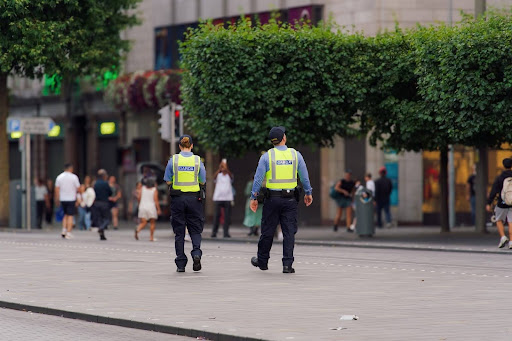
I have spent much of my life reading regulations, studying photographs, and listening to old hands recall what it meant to “look the part” in the Garda Síochána. Uniforms and badges can seem like surface details. In practice, they are the public face of authority, a promise of service, and a quiet language of belonging. Over the last century, Garda symbols have shifted alongside the organisation itself, reflecting changing politics, policing philosophies, and the everyday realities of working on Irish streets.
Why Symbols Matter In Irish Policing
Legitimacy, reassurance, continuity, and accountability sit at the heart of Garda symbolism. A uniform signals the authority of the State, but it is also meant to reassure—presenting Garda members as approachable as well as firm. Badges and insignia connect today’s organisation to earlier generations, while clear identification supports professional standards and public trust.
1. The Early Garda Identity: Building A New Image
When the Garda Síochána was founded in the early 1920s, it was tasked with something unusual: establish policing legitimacy in a new State while avoiding the image of an occupying force. That goal shaped how the organisation presented itself.
Early choices emphasised a distinct civic identity through a deliberately non-militarised appearance, a recognisable cap and tidy dress standard that looked disciplined without looking like a soldier, and an emphasis on the word “Síochána” itself—signalling peacekeeping rather than coercion.
What is often missed is that uniform policy was not only about appearance. It was about communicating what kind of policing Ireland wanted.
2. Badges And Crests: From Practical Markers To National Symbolism
Badges began as practical items: clear markers of membership, authority, and rank. Over time they took on deeper meaning.
Key developments in Garda badge culture typically involved standardisation (so the public could recognise Garda members across the country), clarity of rank (visual signals that supported discipline and command), and national identity (the gradual incorporation of Irish-state symbolism into crests and insignia as institutions matured).
In a small country, symbols carry weight. A crest on a cap is not only decoration. It is a compact statement: “This person represents the State, and the State is accountable for them.”
3. Rank Insignia And The Growing Professional Structure
As the organisation expanded, so did the need for visible rank distinctions. Insignia had to do two jobs at once:
Insignia had to do two jobs at once: internally, it allowed members to identify authority quickly in the field; publicly, it signalled professionalism and order.
The balance is delicate. Too little differentiation can create confusion. Too much can appear overly militarised. Garda design choices across the decades have tended to seek a middle line: disciplined, formal, but still recognisably a civic police service.
4. The Move Toward Modern Operational Uniforms
Late twentieth-century policing demanded different practicalities: traffic management, public order operations, and new expectations around safety.
This is where we see a clear shift in Garda symbolism, because practical changes alter “identity” whether intended or not. High-visibility materials made Garda members more visible—especially on roads—while also changing the public’s visual association of Garda work. Protective equipment became more common in certain duties, signalling preparedness for risk, and weatherproof, functional clothing became essential to everyday policing rather than optional.
These changes tell a story: the Garda role became more complex, more regulated by health and safety norms, and more exposed to scrutiny through media and public recording.
5. Name, Number, And The Question Of Identification
Modern policing has increasingly emphasised traceability. In day-to-day terms, that means visible identifiers and consistent presentation.
Identification practices support public confidence (it is easier to raise a concern or give a compliment when a member is identifiable), professional protection (clear ID can defend members against false allegations), and operational standards (consistent dress and ID reduce ambiguity in critical incidents).
In discussions about symbols, this is where history meets current events. Public expectations today include transparency, while members also need practical protection from harassment. Uniform policy must weigh both.
6. Ceremonial Dress: Tradition With A Purpose
Ceremonial uniform elements can look old-fashioned, but they serve an organisational role: commemoration (honouring members and remembering key moments), institutional pride (reinforcing standards and esprit de corps), and public connection (offering a visible, respectful presence at national and local events).
In Ireland, where memory and legitimacy are never far from the surface, ceremonial symbolism helps the organisation place itself within the civic life of communities.
7. What Today’s Symbols Communicate (Whether Intended Or Not)
Every era reads the uniform differently. In one decade, a formal tunic may signify professionalism; in another, it may feel distant. High-visibility kit can feel reassuring to some and overly enforcement-focused to others.
Symbols are not static. They are interpreted through the public mood, the media environment, and people’s lived experiences with Garda members.
Closing Thoughts: Evolution, Not Abandonment
When people say, “The Garda uniform has changed,” they often mean more than fabric and badges. They mean the relationship between policing and public life has changed.
The enduring task has stayed remarkably consistent: to present authority that is legitimate, accountable, and rooted in service. The symbols have evolved to match new realities, but the question at the heart of Garda identity remains the same.
If you have old photographs of family members who served, or stories of how uniforms were worn in your area, I would love to hear them. The history of Garda symbols is not only written in regulations. It is stitched into memories.
Written by Sean Daly Garda